During his discussion of the book of Job, Dr. Boyer introduced a concept that initially seemed straightforward, but continues to influence my understanding of the texts and institutions I encounter in Humes: form versus content. Dr. Boyer explained poetry as focused on linguistic form—the structure and words a poet employs—rather than the content of its text. In fact, the content of the text actually has no meaning without its linguistic form. Form generates the “illusion” of meaning (Boyer).
As I consider linguistic forms in relation to justice, I also find myself reflecting on linguistic, legal, and even physical form more generally. To further explore the idea of form as meaningful in and of itself, I visited Clayworks Inc. in Charlotte to experiment with a new-to-me form: pottery. With instruction and support from Clayworks’ staff, I sculpted two simple pottery pieces, a bowl and a mug, pictured below.


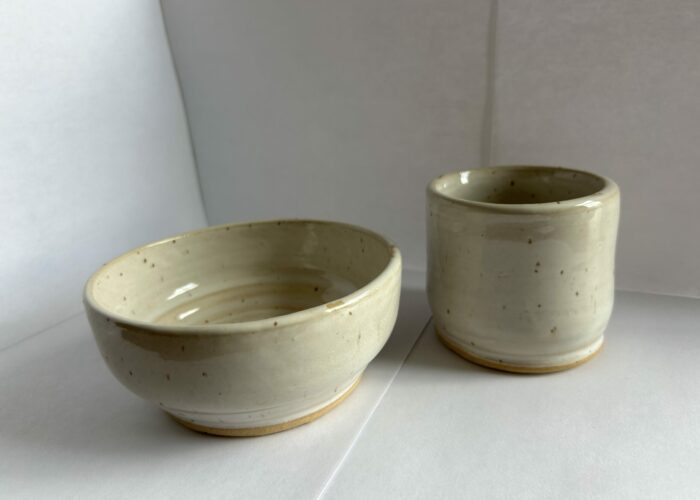
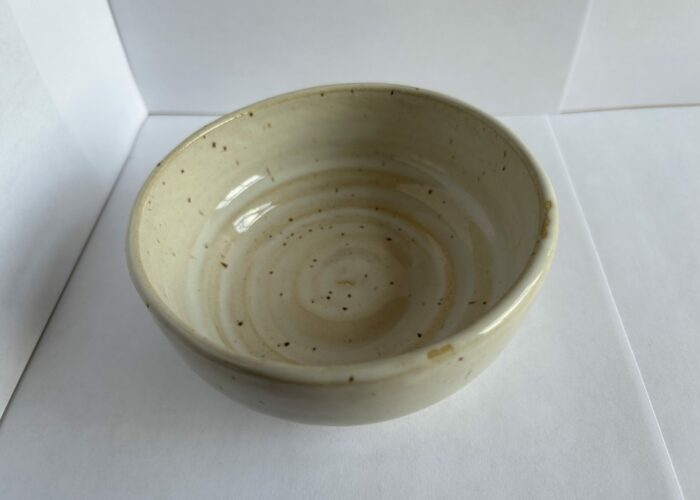

I did not produce any justice through my pottery experiment. However, I did give an unassuming lump of clay an explicit purpose: providing meals. Only through its transformation to a (slightly lopsided) bowl and cup can my clay serve this purpose—or, in other words, only through its new form.
I understand justice as a concept that may be impossible to actualize in our imperfect world, no matter what form of justice we choose. However, my pottery experience reminds me that form has meaning in and of itself. Perhaps, I consider, forms of justice are meaningful too. Even if they do not offer justice itself, they offer a structure through which we can strive for a little more impartiality and a little more fairness.
Works Cited
Boyer, Patricio. “The Book of Job.” September 2024, Humes 103, Davidson College, Davidson, NC. Lecture and slideshow.
